A Brief History of Wolviston Village
The village of Wolviston has a long history, possibly as far
back as Saxon times, and is certainly able to trace its direct roots to pre date
the Norman Conquest of 1066. This may be ascertained by the name changes the
village has undergone during its long history. The original name is thought to
have derived from Wolfs Tun (or town) after a Wolphere, an Anglo Saxon baron who
it is thought may have been a landowner in the area.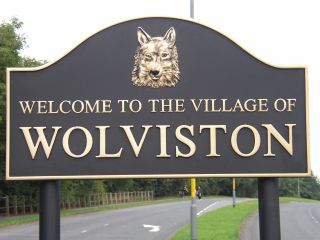 There are however records
of a Wulfhere, son of Penda, a Saxon noble who in the year 657 was proclaimed
King of the Mercian's. Slowly over the next few years Wulfhere had made himself
supreme in Southern England and by 665 the Kings of Essex had become his
subjects. By 670 it is probable that the whole of Southern England was under his
control, however there is no mention of him in Bede`s list of the Southern
Overlords. In 674 it is reported that Wulfhere invaded Northumbria and the lands
North of the Tees at the head of an army drawn from all the Southern English
peoples, but he was defeated by Ecgfrith, son of Oswiu, sometime during 675. If
Wolphere and Wulfhere are perhaps one and the same person, historical writings
are now both uncertain and unclear.
There are however records
of a Wulfhere, son of Penda, a Saxon noble who in the year 657 was proclaimed
King of the Mercian's. Slowly over the next few years Wulfhere had made himself
supreme in Southern England and by 665 the Kings of Essex had become his
subjects. By 670 it is probable that the whole of Southern England was under his
control, however there is no mention of him in Bede`s list of the Southern
Overlords. In 674 it is reported that Wulfhere invaded Northumbria and the lands
North of the Tees at the head of an army drawn from all the Southern English
peoples, but he was defeated by Ecgfrith, son of Oswiu, sometime during 675. If
Wolphere and Wulfhere are perhaps one and the same person, historical writings
are now both uncertain and unclear.
During the eleventh century the village was known as Olverstona
and in the sixteenth century we see it change again to become Wulston. Even as
late as the later part of the seventeenth century, Surtees in Volume III of his
History and Antiquities of the County Palatine of Durham calls it Woulston.
During its early life the village, like so many others of its
type may only have been a small and generally poor settlement, heavily reliant
on agriculture and livestock. The profits from which would have gone into the
coffers of the Prior of Durham under whose ownership and tenancy the lands would
have derived. The general composition of the village would have followed a
similar pattern to other rural and farming villages both within County Durham
and the North East generally. A central green and a pond for cattle and other
animals to graze and drink at, small linear plots of land for agriculture
following the Saxon and later the Norman land management systems surrounded by a
grouping of huts or dwellings.
During 1349 the Black Death hit the area hard. The aftermath of
this being an acute shortage of labourers or serfs to work the land for the
Prior of Durham, the free tenants being unwilling to work the land for what they
saw as meagre rewards left the land to go untended for many years. Many of the
houses also, left uninhabited by the sheer volume of deaths, fell into ruin and
a state of dereliction. However by 1384 records show us there was again about
500 acres of lands belonging to the Prior of Durham back in cultivation mainly
through the efforts of the free tenants who seeing it more profitable to
cultivate the lands themselves than have their tenancies revoked for allowing
the land to fall fallow and thus not create income.
The village population had recuperated sufficiently by 1569 as
to allow the provision of nineteen villagers to join others from Newton Bewley
and parts of Hartlepool as part of a larger uprising being led by the Northern
Catholic Earl's of Northumberland and Westmorland against the protestant throne
of Elizabeth I. The uprising was a complete failure due to a general lack of
support, despite limited success for the Catholic cause during the early days of
the uprising. The protestant throne immediately took punitive measures and
retribution was swift against the perpetuators, with the result that four of the
Wolviston men amongst others were publicly hanged.
Wolviston became a separate parish after 1577 and around this
time the profits and income devolved from the Prior of Durham to the Dean and
Chapter of Durham Cathedral. The village has had two buildings that have served
as its parish church. the first being dedicated to St Mary Magdalene which is
understood to date from around the time of the twelfth century and stood on the
old North Kevyll Street close to Church Row. Little now historically is known
about this church, apart from during the sixteenth century it was so little used
that it fell into disrepair. In 1716 it was restored to some of its former glory
and was described as having a square tower on the south side of the nave with
the entrance at its base. The church is reported to have had a capacity of about
320 but it was said to chilly and poorly lit within. By the 1870s the church was
again in some state of disrepair and was rapidly becoming surrounded by cottages
being built to house an influx of labourers, that there came a point when there
was no where to bury the dead.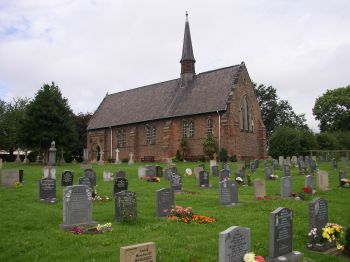 A new church dedicated to St Peter complete with
its own burial ground was built in 1876 on ground behind the High Street and
opposite the Wesleyan Chapel, for a cost of £ 2,315. The old church was finally
demolished in 1878. A condition for demolishing the old church had been
that its land would not be used for anything other than a garden or plantation.
In 1977 under the Redundant Church Act this condition was allowed to be broken,
and the former church land was sold to a private builder who then built a house
on the site. Some of the profits from the sale of the land went to offset the
costs of £ 6,000 that were required during alterations and enhancements to St
Peters church during 1969-72 which included; a new meeting room, new entrance
porch, toilets, vestry, kitchen and storeroom.
A new church dedicated to St Peter complete with
its own burial ground was built in 1876 on ground behind the High Street and
opposite the Wesleyan Chapel, for a cost of £ 2,315. The old church was finally
demolished in 1878. A condition for demolishing the old church had been
that its land would not be used for anything other than a garden or plantation.
In 1977 under the Redundant Church Act this condition was allowed to be broken,
and the former church land was sold to a private builder who then built a house
on the site. Some of the profits from the sale of the land went to offset the
costs of £ 6,000 that were required during alterations and enhancements to St
Peters church during 1969-72 which included; a new meeting room, new entrance
porch, toilets, vestry, kitchen and storeroom.
The education of
the village children has since the early nineteenth century been well provided
for. There has been in total three schools within the village over the years the
first being built by the Church of England National Society for the Education of
the Poor. This school became known simply as The National School. Attendance at
The National was not compulsory but those children that did attend soon found,
with good reason, that a school being built and funded by the church expected
that religious instruction was at times more important than the basic three R`s.
In 1836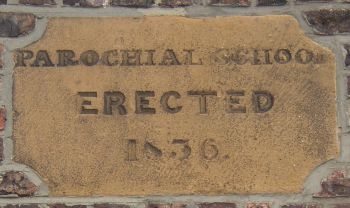 a second school was founded and constructed next to the Wesleyan Chapel
on the High Street and was called the Parochial School. This school had the
capacity for a hundred pupils and remained in constant use for forty years until
it closed in 1876. It in turn was replaced the following year by the third and
final school, the Wolviston Board School. The Board School had set about
attempting to purchase land for the new school two years earlier, but it was not
until 1876 that an agreement was reached on a plot of land on the green for the
new building which is where the current village school still stands to this day.
Parents of children attending the Board School soon found that education was not
free. They had to pay 6d (2½p) per week for the first child in the family
attending and 4d (just under 2p) for the second or any subsequent children
attending, fee paying was eventually abolished fifteen years later in 1891.
a second school was founded and constructed next to the Wesleyan Chapel
on the High Street and was called the Parochial School. This school had the
capacity for a hundred pupils and remained in constant use for forty years until
it closed in 1876. It in turn was replaced the following year by the third and
final school, the Wolviston Board School. The Board School had set about
attempting to purchase land for the new school two years earlier, but it was not
until 1876 that an agreement was reached on a plot of land on the green for the
new building which is where the current village school still stands to this day.
Parents of children attending the Board School soon found that education was not
free. They had to pay 6d (2½p) per week for the first child in the family
attending and 4d (just under 2p) for the second or any subsequent children
attending, fee paying was eventually abolished fifteen years later in 1891.
Over
the years, many alterations and additions have followed but the basic school,
and its location remains the same now as it did then. There have been
two periods during the mid to late nineteenth century when a small brick and
tile works, then later an associated pottery, had been established on the
outskirts of Wolviston. These ventures developed and flourished mainly due to
the discovery of good quality clay to be found at the south end of the village.
It is believed that the Rev L C Clarke first started the brick and tile works
around the end of the 1820s and certainly the tithe records of 1841 show the
works as a going concern, and the pottery was certainly also a profitable part
of the business during this period. Its main items of manufacture would have
been no more than simple and basic domestic ware. It was perhaps the combination
of a limited local market for this type of earthenware added to this the
expansion of general transportation, including effective railway links in
particular, that opened up a wider availability of better quality domestic pots,
bricks and tiles at a cheaper cost from larger potteries as far away as
Staffordshire. The final downfall of the pottery, re-opened for the last time
and operated by John Codling and Sons in 1892, was simply down to the source and
quantity of clay running out. The brick works and pottery eventually closed its
doors for the last time in 1905. The buildings were finally demolished and the
site landscaped and returned to agricultural use in 1918.
The village is located on what had at that time been the main turnpike
road from Stockton on Tees to Sunderland.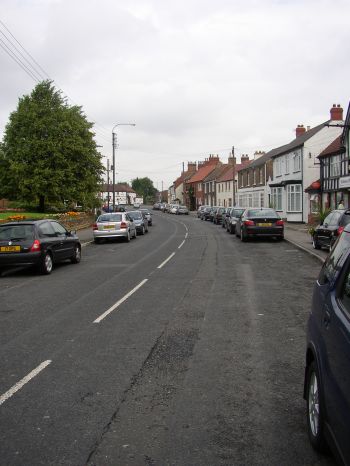 Its position on the busy main road allowed adequate trade
from individuals in transit and extra income for the various shops, businesses
and during the late 1830s, the six public houses. It was probably due to its
constant use as a stopping point to and from Sunderland and its port that
brought problems to the village. Asiatic cholera arrived in Sunderland during
the early 1830’s and within the year it had reached Wolviston, the cholera
returned twice more, once in 1854 and again in 1866. Being on the main
thoroughfare between Stockton on Tees and Sunderland, and later in some respects
Billingham, originally brought many benefits to the village and its population.
The decline of the coaching trade and later with the growth of the car turned
what had been an asset into a liability for the village’s development. Traffic
congestion increasingly made life a misery for many local people. The worst of
the inconvenience was overcome by the construction of a by pass for the busy A19
East of the village in 1969 and fourteen years later in 1983, a newer A19 by
pass was constructed to the West of the village.
Its position on the busy main road allowed adequate trade
from individuals in transit and extra income for the various shops, businesses
and during the late 1830s, the six public houses. It was probably due to its
constant use as a stopping point to and from Sunderland and its port that
brought problems to the village. Asiatic cholera arrived in Sunderland during
the early 1830’s and within the year it had reached Wolviston, the cholera
returned twice more, once in 1854 and again in 1866. Being on the main
thoroughfare between Stockton on Tees and Sunderland, and later in some respects
Billingham, originally brought many benefits to the village and its population.
The decline of the coaching trade and later with the growth of the car turned
what had been an asset into a liability for the village’s development. Traffic
congestion increasingly made life a misery for many local people. The worst of
the inconvenience was overcome by the construction of a by pass for the busy A19
East of the village in 1969 and fourteen years later in 1983, a newer A19 by
pass was constructed to the West of the village.
Wolviston is a
village, which in many ways had been unaffected directly by the industrial
revolution, the blast furnaces and shipyards of Hartlepool and the upper reaches
of the River Tees lay to the South and East. Stockton on Tees had been in the
past a flourishing port and would remain so for many years. The industry of the
River Tees had not affected the rural life of the village. Clearly, there were
those who went into the industrial heartland of Teesside and Hartlepool for
employment. The Durham coalfields and the ports of Seaham and Sunderland to the
North also took men from the village. There was a certain amount of local
industry, which employed some, but the foremost and largest direct and indirect
employer from the village and surrounding areas was Wynyard Estate, the then
seat of the Marquis of Londonderry.
All photos: Peter Fellowes.
Return to the Main Page