325687
Private Robert Henry Watson.
1/9th
Battalion Durham Light Infantry.
Born
1898 at Wolviston.
Died
of Wounds at 56 Casualty Clearing Station 29th March 1918.
Buried
at Gezaincourt Communal Cemetery Extension, Somme.
Son of
William and Sarah Watson of Lax Terrace Wolviston.
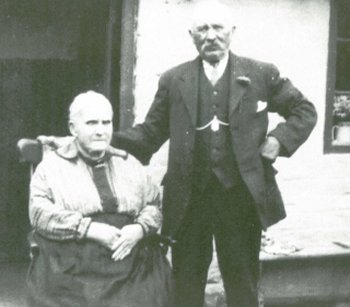
Robert Henry Watson was born in 1898 at Wolviston. He was the youngest of the six children born to William and Sarah, the five elder children were; Mary, Thomas, Margaret, William, and John, who also was to be killed in France on the 11 April 1917. The 1911 census shows Robert aged 13 and still attending school.
William and Sarah Watson [c 1925]
Partly
due to severe losses during and after the Battle of Loos in September 1915 and
partly due to a general reduction in volunteer recruitment Lord Derby was
appointed Director General of Recruitment in October 1915. Already there were
the minor rumblings of compulsory conscription in the not too distant future if
in some way voluntary recruitment numbers could not be increased. Lord Derby
introduced a scheme which was to become known as the ‘Derby Scheme’, for men
between the ages of 18 and 40 to either enlist now or register for a call up if
and when required. Those who chose to register for a later call up if required
were placed into various groups depending on age and marital status. The scheme
closed on 15 December 1915 and had produced another potential two million
recruits however overall the scheme was deemed a failure and on 2 March 1916
the Military Service Act came into effect bringing in for the first time in the
country’s history compulsory conscription.
Robert was one of those two million who came under the ‘Derby Scheme’. On the 11 December 1915 Robert reported to the recruiting office in Stockton and enlisted for Short Service [Duration of the War] into the 2/8th Durham Light Infantry deferring his enlistment for call up as and when he was required. However one point here was that if Robert was born in 1898 and he enlisted in December 1915 whatever way you look upon it he would have only been only a few months or so passed he 17th birthday, underage for enlistment. Robert however declares on his enlistment form that he is 19 years and 1 month old.
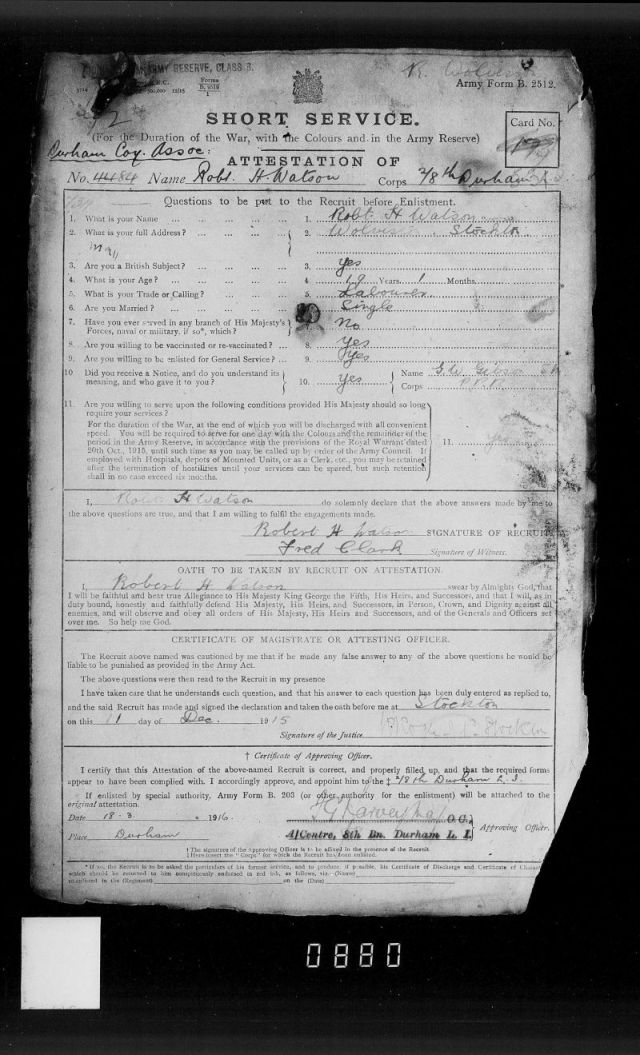
Enlistment Sheet showing Robert lied about his age.
He is then transferred to the Army Reserve Class B and sent home again to await call up under his ‘Derby Scheme’ group classification as and when required.
On the 18
March 1916 he receives his mobilization call up and reports to 2/8th
Battalion Durham Light Infantry. On the 22 August 1916 he is transferred to the
1/7th Battalion and on the 1 September transferred again into the
3/5th Battalion which along with 3/6th, 3/7th,
3/8th and 3/9th Battalions all amalgamated to form 5th
Training Reserve Battalion. Only three scant pages remain of his service
records and so it is not possible to say for certain when he was finally
transferred to the 1/9th Battalion or when exactly he moved to
France to join the battalion.
Robert has two regimental numbers showing on his Medal Index Card. The first 9/7311 and later this changed to 325687 as part of the new regimental numbering system that was introduced in 1917. The regimental number with the prefix 9 shows that he was serving in the 9th Battalion Durham Light Infantry prior to the new numbering system coming into effect. We do know however that the Medal Roll [WO329/1267] does show Robert as serving in the 1/9th Battalion at the time of his death. Robert’s Medal Index Card shows a medal entitlement of the British War Medal and the Victory Medal.
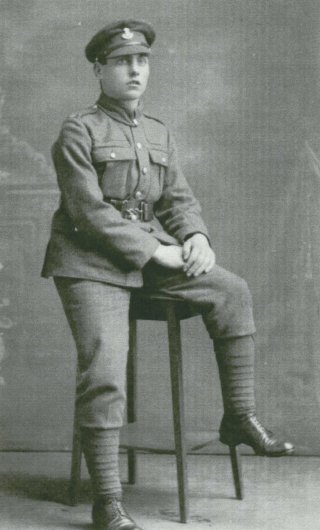
Robert Henry Watson
The 9th
Battalion Durham Light Infantry [Territorial Force] was a pre-war territorial
[part time] battalion owing its origins to a number of Rifle Volunteer units
from Gateshead, South Shields, Blaydon, Burn and Winlaton areas. After the
outbreak of war, in common with other territorial units, it formed itself into
two, and later three [or more] lines, in order to accommodate those who rushed
to enlist. These were known respectively as the 1/9th, 2/9th,
3/9th and so on. The 1/9th
Battalion were to remuster as the Pioneer Battalion for the 62nd
Division and transferred from 151st brigade 50th
Division into the 62nd Division with effect from February
1918.
This extract from the Battalion War Diary gives details of the action during which Robert became wounded:
26th - 31st March.
At dawn we were ordered to retire to a position behind BUCQUOY – PUISIEUX Road where we were in support. About 8.30am enemy attacked and the front line troops had to withdraw and we became [the] front line. The enemy attacked in great strength and was held up on our front but penetrated beyond our right flank. As there were no troops on our right rephased the flank back to ROSIGNOL WOOD. The Brigade front was now held intact by [the] 9th DLI and 2/5th Duke of Wellington Regiment until the night of 31st March / 1st April when we were relived by 8th West Yorks and we moved to reserve at RATTEMOY FARM.
The enemy completely failed to penetrate the line and we captured 10 prisoners including guards.
Casualties:
Capt Lisle, Lt Wylie MC and 2 Lt Bell Killed.
Lt Boram and Lt Fisher Wounded.
23 Other Ranks Killed
86 Other Ranks Wounded to Hospital
2 Missing.
We know that Robert Watson would have been one of those 86 wounded sent to hospital with multiple shrapnel wounds and he was taken to Number 56 Casualty Clearing Station at Gezaincourt suffering from multiple shrapnel wounds. He later died of his wounds during Friday the 29th March.

56 CCS Admissions Sheet showing Robert arrived with Multiple Shrapnel Wounds
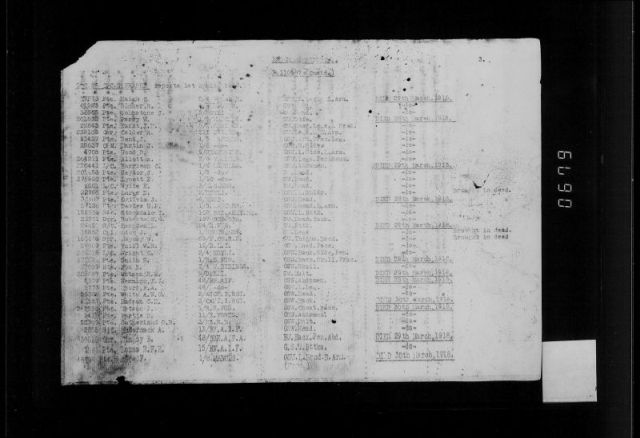
56 CCS Daily Returns for 29 March showing Robert had died.
Robert
left a sum of £9 2s 2d within his financial effects to his mother Sarah which
she received on 10 June 1918. The war office also paid Sarah a war gratuity of
£8 10s in 1919 due to the death of Robert.
Robert
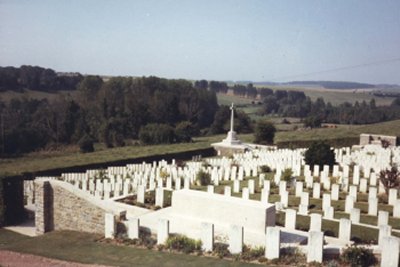
Henry Watson is buried at Gezaincourt Communal Cemetery Extension, Somme
France. His grave number is I. H. 14.
Gezaincourt
is a village a little to the south west of the town of Doullens. The Communal Cemetery
and Extension are on the east side of the village. The Extension was opened in
March 1916 and used until March 1917 and again from March to October 1918. The
burials carried out, in most cases, from Casualty Clearing Stations and [in
June to August 1918] from 3rd Canadian Stationary Hospital. There are now over
600 1914-1918 and 10 1939-1945 war casualties commemorated in this site.
Enlistment Sheet and 56 CCS Returns National Archives
Photo of Robert Henry Watson: Mrs Doris Yuill.
Photo of William and Sarah Watson: Mrs Doris Yuill.
Photo of Gezaincourt Communal Cemetery Extension: Commonwealth War Graves Commission.