20542
Guardsmen Robinson Booth Brown.
2nd
Battalion Grenadier Guards.
Born
1879 at Wolviston
Killed
in Action 28th March 1918.
Remembered
on the Arras Memorial, France.
Son of
Robinson and Mary Brown of Wolviston
Husband
of Frances Brown [nee Drew] of Bishopton.
Robinson Booth Brown was born in Wolviston in 1879 to Robinson and Mary Brown. Robinson [junior] was the sixth and final child, there being three elder brothers and two elder sisters. Robinson [elder] was employed as an agriculture labourer and his mother, Mary, worked occasionally in a laundry.
Robinson married Frances Drew at St Edmunds Church at Gateshead on the 19th January 1901; they were both 22 years old. They set up home together at Front Street in Bishopton near Stockton on Tees where Robinson was employed as labourer. On the 17th of June 1901 they adopted a girl, Mabel Hetty (Cattererson), in Stockton on Tees. It is not yet clear how Mabel came to be adopted so soon [five months] after Robinson and Frances married. Frances had not been married prior to marrying Robinson, but it may be possible that Mabel may have been the illegitimate child of Frances or even perhaps the daughter of either of Robinson’s two elder sisters, Elizabeth or Sarah or Frances’ elder sister Harriet.
Robinson enlisted into the Grenadier Guards on the 17 November 1914 at Stockton on Tees on a short service, for the duration of the war engagement; he was just over 35 years old.
20542 Private Robinson Booth Brown Grenadier Guards reported for recruit training at Caterham two days later on the 19th November 1914.
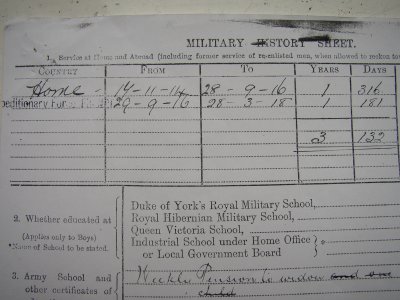
Robinson, or rather his service record, now slightly becomes an enigma as the remainder of the story unfolds. On his service record ‘Military History Sheet’ it very clearly states that he served at home from 17th November 1914 until the 28th September 1916, [a total of 1 year and 316 days]. His record then shows his deployment overseas and landing in France on the 29th September 1916. It then shows he served in France and Flanders from that date until he is killed in action on the 28th March 1918, [1 year 181 days later]. We will pick up on this point later.
R B Brown Military History Sheet clearly showing Home and Overseas service dates
By the 26/27th March 1918 the 2nd Battalion Grenadier Guards found themselves in a position astride the Arras – Albert railway line, in an area of low ground and being overlooked from the outskirts of the town of Moyenneville. On the morning of the 27th September just after dawn, enemy infantry could be seen and gave the impression of preparing to advance in large numbers toward the allied front line. The Germans had begun to use new methods of advancing. Rather than a massed advance in close formations, they had started to employ the tactic of advancing by running forward in groups of two’s and three’s, copying much the same type of tactical advance as was now being used by the British. The strength of this method of advance is that in general there is not a large enough target for artillery to fire at, conversely however it takes a disproportionate amount of small arms fire with often very little result to counter it. However on this day all companies of the battalion started to open fire as targets presented themselves and Number 1 Company was in a position to enfilade fire on the enemy to very great effect. The result of this was that the Germans soon found they were unable to make any headway with their advance. During this fire fight the enemy artillery had started to fire heavy rounds into the battalion position, this was backed up by German machine gun and sniper fire coming from the high ground to the front around the outskirts of Moyenneville with the result that both 2 and 4 Companies started to receive casualties. The German attack did not continue to progress at this point of the line and started to swing to the South and towards the area held by 3rd Battalion Grenadier Guards and 4th Guards Brigade.
Before daybreak the next morning [28th March] patrols from Number 4 Company were reporting that large numbers of the enemy were assembling only 100 yards from the battalion front trenches, however these were soon dispersed by artillery fire. During the remainder of the day both Number 1 and 2 Companies were under almost constant enemy artillery fire and machine gun fire, again from the high ground to their front, and during this barrage the enemy infantry made continued efforts to penetrate the battalion line. The battalion casualty figures on the 28th March were 22 killed and 42 wounded. Robinson Booth Brown was among these casualties.
Now I come to the medals that Robinson Booth Brown was awarded [entitled] and this brings me back to earlier point that I made about his Service Record. As mentioned [above] his ‘Military History Sheet’ very clearly gives his service record as:
Home 17/11/14 to 28/9/16. 1 year and 316 days.
Expeditionary Force France 29/9/16 to 28/3/18. 1 year and 181 days.
Total Service. 3 years and 132 days.
Killed in Action 28 March 1918.
If this information is taken to be correct and there might be initially no reason why it should not, then Robinson Booth Brown would only have been entitled to the following medals: Victory Medal and the British War Medal. Medal Roll GG/103B2 Page 64 [WO329/610] endorses that entitlement showing that he was awarded the two medals.
However Medal Roll GG/1B Page 24 [WO329/2603] also shows him being entitled to the award of the 1914 – 15 Star, and to qualify this [the Medal Roll] shows a date of disembarkation on French soil as 29/9/15.
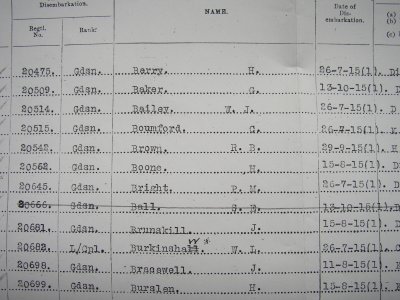
Extract from the Medal Roll GG/1B Page 24 [WO329/2603] clearly showing Brown R B as having disembarked on 29/9/1915 and therefore being entitled to the 1914-15 Star
So we have to come to some conclusions or at least make some reasoned assumptions on the known information available.
1) There were many soldiers with the name Brown; it is after all a common enough name. Perhaps there was some confusion or mix up. That might be true if it were not for the fact that his two Christian names are unusual, Robinson Booth. Both these names and at least both the initials of RB are used on all documents. This alone discounts the possibility of being mixed with another Brown even from the same Battalion and Regiment.
2) His dates given on his ‘Military Service Sheet’ are wrong. Perhaps they should read that he served at home from 17/11/14 till 28/9/15 [not 28/9/16] he then embarked to France landing on 29/9/15. If these dates were correct then he would indeed be entitled to the 1914-15 Star. After all if he did serve at home, as stated, from 17/11/14 till 28/9/16 that, on the face of it, seems a very long time to remain in England, but we must not disregard it as impossibility.
3) His ‘Military Service Sheet’ does show the correct dates. He did not embark for France until the 28/9/16 landing there the next day on the 29th. If this is the case then he is not entitled to the award of the 1914-15 Star as shown by entitlement on the Medal Roll GG/1B Page 24 [WO329/2603] as he did not serve within the qualifying period.
4) There is just one final assumption that I may make. The dates on his ‘Military Service Sheet’ are [for whatever reason] correct. He did not land in France until the 29/9/16. He was therefore not entitled to the 1914-15 Star. The award entitlement was made on the Medal Roll GG/1B Page 24 [WO329/2603] but later the error was noticed and the issue of the medal was in fact never made, or if it was it was at a later date claimed back.
Whatever the correct version of events is we may never know, perhaps it will just be one of the imponderables that we have lost over time. However the closing note in the story of Robinson Booth Brown is that his widow Frances and their adopted child Mabel, was that they were informed of his death on the 17th April 1918. Frances was awarded a pension of thirteen shillings and nine pence commencing from the 21st October 1918.
There is now an update to this story and the question regarding which date Robinson Booth Brown did first serve overseas and if his Military Service Sheet has the correct dates or not. I have recently been contacted by Kevin Keay, whom I know via the Cleveland Branch of the Western Front Association, of which we are both members. Kevin is an amateur medal collector and also in the past has carried out research on the Wolviston War Memorial.
Kevin very kindly contacted me and informed me he had the 1914 -15 Star awarded to Robinson Booth Brown and has allowed me to reproduce copies of the front and rear of the medal.
So it is without any doubt that we can close the medal query. Robinson Booth Brown is entitled to and was awarded the 1914 – 15 Star. The transcription on his Military Records Sheet stating that his first date of service overseas of 28/29 September 1916 is incorrect and it should read 28/29 September 1915.
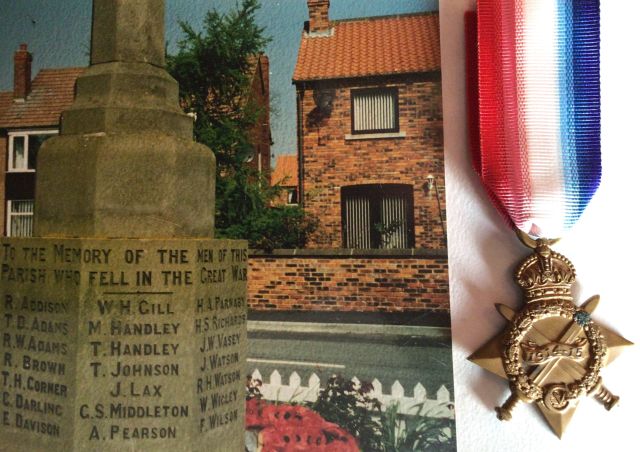
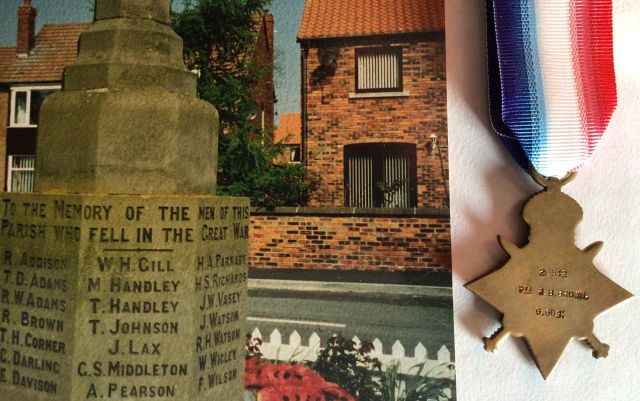
Robinson Booth Brown has no known grave and is remembered on the Arras Memorial, Pas de Calais, France. Bay 1. You will note that on the memorial he is listed under the rank of Private; The Guards Regiments did not adopt the rank of Guardsman from the rank of Private until 1920 though some documentation [above] does correctly show the rank as Guardsman.
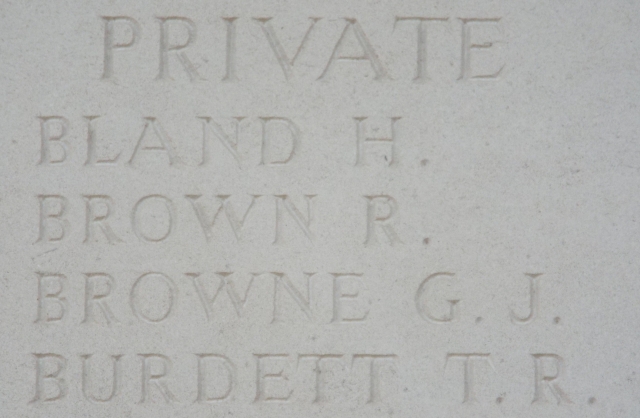
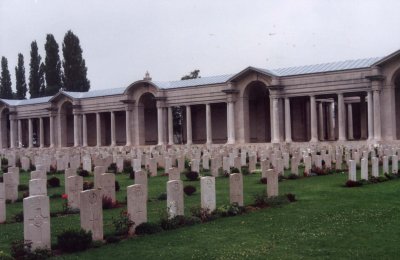
Photo of Military History Sheet and Medal Roll: Peter Fellowes.
Photo of Arras Memorial Bay 1: Peter Fellowes.
Photo of Arras Memorial: Common War Graves Commission.
Photo of 1914 - 15 Star: Kevin Keay from his private collection.