S/4720
Acting Corporal John Watson.
13th
Battalion Rifle Brigade (Prince Consort's Own).
Born
1893 at Wolviston.
Killed
in Action 11th April 1917.
Buried
at Monchy British Cemetery, Monchy-Le-Preux.
Son of
William and Sarah Watson of Lax Terrace Wolviston.
John Watson was born in Wolviston in 1894. John was the fifth of six children that were born to William and Sarah Watson. John’s elder siblings in age order were; Mary, Thomas, Margaret and William and then a younger brother Robert, who sadly also died during the First World War.
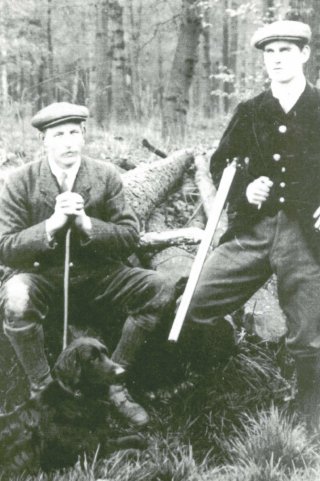
After leaving school John gained employment on the Wynyard Estate, the seat of Lord and Lady Londonderry, he was employed as one of the gamekeepers. The picture shows him [standing] with another [unknown] employee and though there is no date attached to the picture, and with purely an educated guess, it may have been taken about 1914 when he would have been 20 years old.
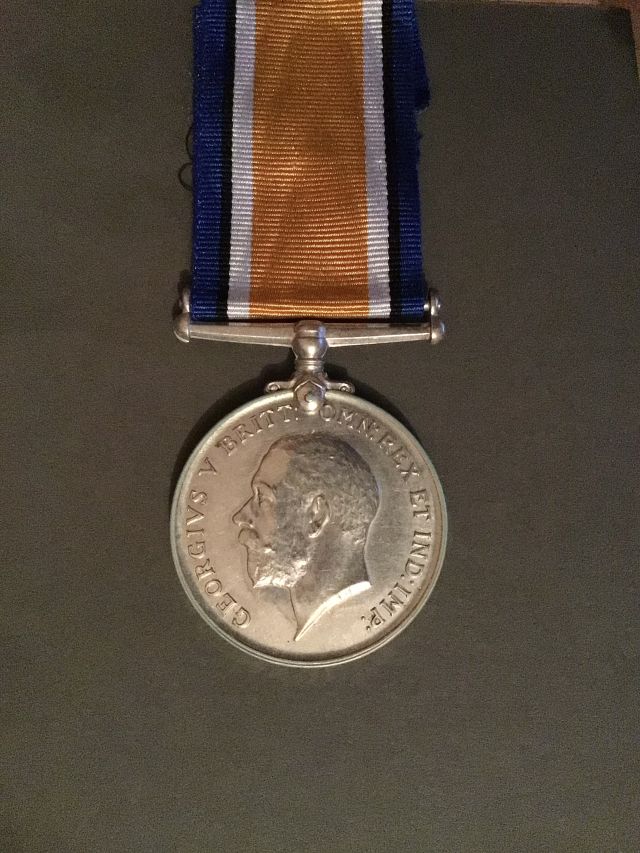
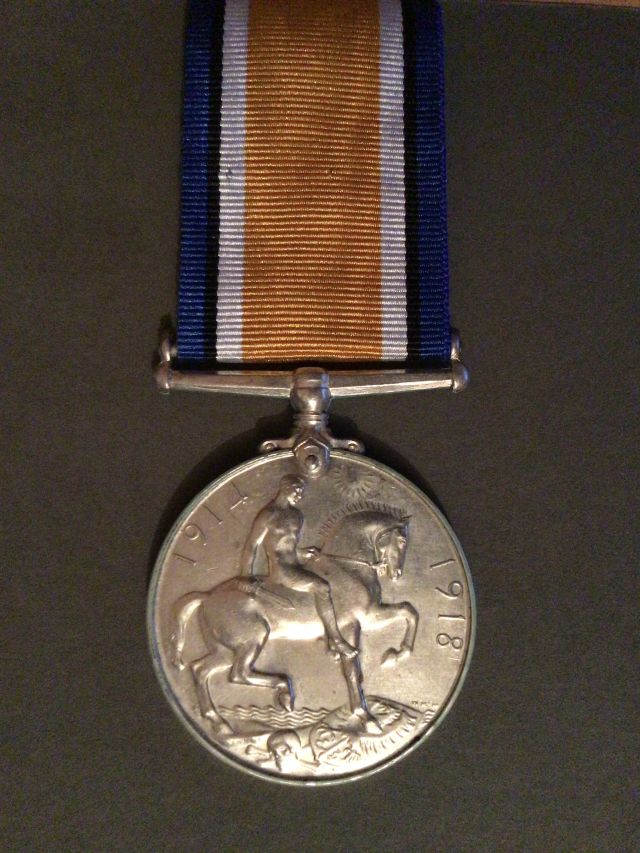
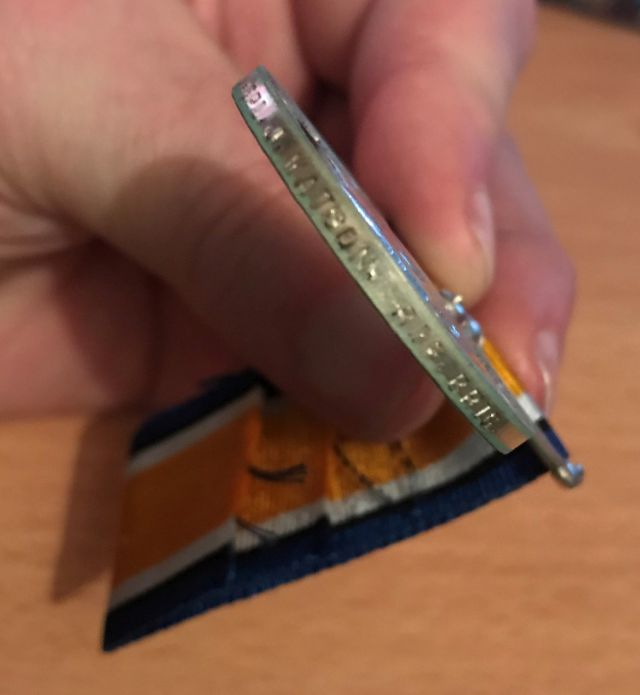
Like so many, John’s service documents have not survived, and so much information has now been lost. However his Medal Index Card, or at least a copy of it, is still in existence and this is able to provide some information from which we may make some basic but informed assumptions, though we do know that he enlisted at West Hartlepool. The Medal Index Card gives the date of his first entry into a war theatre as 29th July 1915, and from this it might be reasonable to come to the conclusion that he enlisted either in late 1914 or during the early months of 1915, consequently allowing for some months of training and possibly a short period of leave before landing in France. It also confirms that John’s medal entitlement was the 1914-15 Star, British War Medal and the Victory Medal.
John enlisted into the 13th (Service) Battalion, The Rifle Brigade (The Prince Consorts Own). The 13th (Service) Battalion had been formed at Winchester as part of ‘Kitcheners Third New Army’ during October 1914. In November 1914 they moved for the winter into a hutted camp at High Wycombe where they remained until April 1915 when they then moved to Andover to join 111 Brigade as part of 37 Division. The brigade landed at Boulogne during the last week on July 1915.
At 4 am on the 10th April 1917 the battalion received orders to move from the position that they had established during the previous evening south of the Feuchy Chapel road to a position near Broken Hill and to make contact with the General Officer Commanding 63rd Infantry Brigade. On arrival they established a defensive position to the left of the 13th Kings Royal Rifle Corps.
At about 11 am the battalion received orders to be ready at 12 am to move to the attack on Monchy Le Preux, the battalion moved in artillery formation as the reserve battalion of the brigade.
The advance was held up at about 5 pm. The battalion sent forward two companies to support both the 10th and 13th Battalions Royal Fusiliers and the battalion retained one company and four Lewis Guns on a plateau West of Monchy Le Preux. The situation at this point was that both the 10th and 13th Battalions Royal Fusiliers were about 300 yards short of the village of Monchy Le Preux and were digging into defensive positions assisted by elements of the 154th Company Royal Engineers. Two companies of the 13th Kings Royal Rifle Corps were also forward in the line in support with one company in reserve. The general situation was explained to the commander of the supporting artillery group and he ranged his guns to fire on the Germans located to the South of Monchy Le Preux.
Shortly before 1 am on the 11th April units of 111th Brigade received verbal orders from the Brigade Major to prepare to continue the attack on Monchy Le Preux at 5 am. The attack formation would be 111th Brigade on the left flank and 112th Brigade on the right. The 111the Brigade attack formation would be; the 13th Battalion Rifle Brigade in the leading wave on the left flank with the 13th Royal Fusiliers in support and the 13th Kings Royal Rifle Corps on the right flank of the leading wave with the 10th Royal Fusiliers in support. There was very little time to regain control and command of the detached forward companies to issue orders and get the companies into position in the assembly trench. The battalion attacked at 5.05 am in the formation of B and D Companies in two waves in front and A and HQ companies in two waves in support with the four Lewis Guns on the left flank. The weather was freezing cold and it was snowing.
The advance started slowly but the brigade line soon extended, as the attack toward the village progressed, enemy fire became more effective and casualties were high among the leading wave. The enemy made good use of their assortment of artillery, machine guns and other small arms and grenades. Once inside the boundaries of Monchy Le Preux the infantry spilt into small groups to search and clear buildings and cellars and by about 9 am the village was in allied hands except for a few limited German outposts that were cleared during the remainder of the day. It was at some point during the attack on the village on the 11th April that John Watson was killed.
John Watson is buried at Monchy British Cemetery, Monchy Le Preux. His grave number is: I. A. 18
Monchy village, a relatively high and commanding position, was captured
by Commonwealth forces on 11 April 1917. The cemetery was begun at once
and continued in use as a front-line cemetery until the German offensive
of March 1918, when it fell into their hands. It was recaptured by the
Canadian Corps on 26 August and used again for a month. The graves are
very closely identified with the divisions which fought on this front.
There
are now 581 Commonwealth servicemen of the First World War buried or
commemorated in this cemetery. 58 of the burials are unidentified but
there are special memorials to a number of casualties known to be buried
among them.
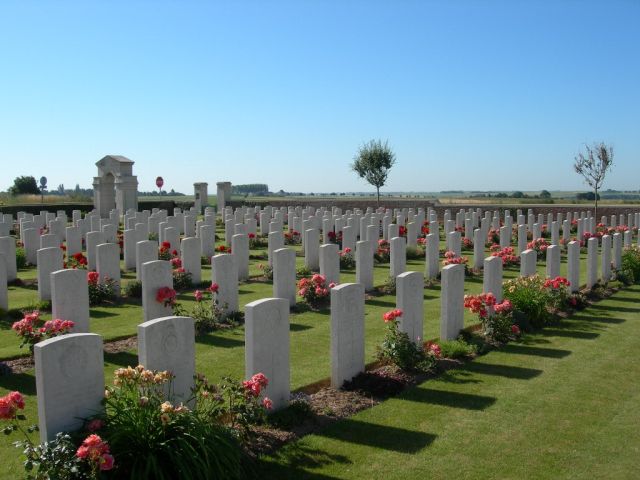
Photo of John Watson: Mrs Doris Yuill.
Photo and information of Monchy British Cemetery, Monchy Le Preux. Commonwealth War Graves Commission.
Photo of British War Medal: Kevin Keay from his private collection.