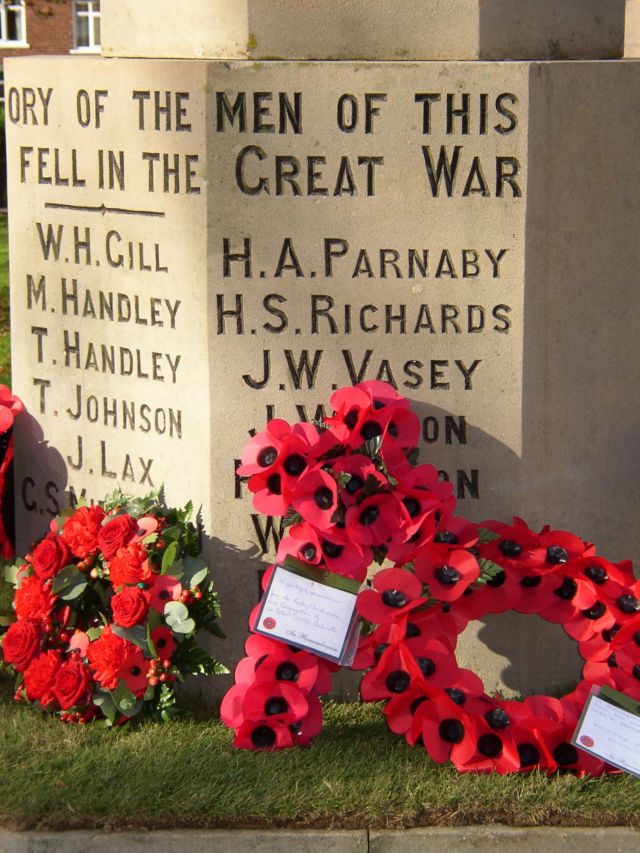
2nd
Lieutenant Henry Scotson Richards.
15th
Battalion Sherwood Foresters (Notts and Derby Regiment)
Attached
25 Squadron Royal Flying Corps.
Born
1896 in West Hartlepool
Died
of Wounds 3rd April 1917.
Buried
at Avion Cemetery [German Extension]
Remembered
on Special Memorial 18 at Cabaret-Rouge British Cemetery, Souchez
Son of
Jessie Richards of Western House Wolviston
The 1901 census shows the family is living at 3 Esplanade Whitley Bay Cullercoats.
Mother Jessie Richards [b] 1868 age 33 a Milliner running her own business from home.
Son Henry S Richards [b] 1896 age 5.
Visitor Elizabeth Woodhouse [b] 1882 age 19 a dressmaker assisting Jessie with the business.
There was also a daughter. Mary Lisle Richards (known as Madge) [b] 1894 age 7. She was staying with grandparents at 9 South Burn Terrace Hartlepool.
It might be noted that there is no father shown.
Israel Richards was a
journalist who it appears had abandoned the family by 1901 and it is
believed that he had
travelled to London to take on freelance work. He was never heard of
again by any member of the family; which as later information will show
would became a slight problem. He had in fact died in late 1922 in
Marlebone London. The main point here is to understand that as
early as 1901 Jessie
Richards is on her own [though with extended family in Hartlepool and
Wolviston] with
two children no husband and running her own milliner business from her
home in
Whitley Bay Cullercoats to make an income.
The 1911 census shows the family home at 18 Birtley Avenue Tynemouth.
Jessie Richards is now shown on her own and still working as a milliner from home.
Henry Richards at Barnard Castle School as a
pupil.
It also records that Mary Lisle Richards had died by the time of this census. In fact Mary died at Hartlepool in 1909.
During the period of starting work in Newcastle in January 1912 until
October 1913 Henry enlisted as a part time member [Territorial Force] of the Northern
Cyclist Battalion.
On the 9 September 1914 Henry arrives at a recruiting office in Hartlepool and enlists and is recruited into the 21st Lancers and given the Regimental Number 3188. On the 29 September 1914 he is sent to Shrapnel Barracks in Woolwich, London where he then remains undergoing training until in April 1915 when he applies for a Temporary Commission.
His application is successful and on the 5 May 1915 he is discharged from the Army and is free to take up a Temporary Commission. On the 7 May 1915 he is commissioned as a [T] 2nd Lt into the 13th [Reserve] Battalion The Sherwood Foresters [Nottinghamshire and Derbyshire] Regiment. The 13th Battalion became the 2nd Reserve Battalion on the 10th April 1915 and remained in England as a training battalion. The battalion was at Lostwithiel in Cornwall when Henry joined to start officer training then in June 1915 the battalion moved to Lichfield. In November 1915 it moved again to Rugeley and finally during the time Henry was there it moved to Brocton and became part of 3rd Reserve Brigade. Henry was later transferred to the 15th [Service] Battalion The Sherwood Foresters [Notts and Derby] Regiment and was posted overseas to join the battalion on the 29th May 1916 at a place called Lacoutre near Neuve Chapelle.
This period is during the run up to the Somme offensive and though Henry is not mentioned by name in any of the war diary entries during this period here is a chronological run down of the 15th [Service] Battalion locations and actions on the Somme during the 1916 offsenives.
3 July Entrained at Chocqes for Bouquemaison and from there marched to Sus-St Leger.
7 July Move to Beauval
10 July Move to Bus-les-Artois
11 July Move to Warloy
12 July Move to Heilly
13 July Move to Grove Town Camp
14 July Move to Billion Wood
16 July Relieved 6th Northamptonshires in trenches SE of Trones Wood
20 July Attack on positions between Maltz Horn Farm and Arrow head Copse
22 July Withdrew at night and to Talus Boise then to bivouacs near Minden Post
24 July Reserve line at Silesia Trench
25 July Consolidated position and Z Company formed garrison at La Briqueterie
26 July Move to Talus Boise
28 July Move to Dublin Trench
29 July Move to bivouacs near Minden Post
31 July Move to Sandpit Valley
1 August Move to Bois des Tailles
5 August Entrained at Mericourt for Saleux
6 August Move to Molliens-Vidame
10 August Entrained at Hangest for Mericourt and from there marched to Citadel Camp
20 August Move to Talus Boise
22 August Move to Maltz Horn Trenches
23 August Move to Billion Wood
26 August Move to Sandpit Valley
28 August Move to Bois des Tailles
30 August Entrained at Heilly for Candas and from there marched to Prouville
1 September Move to Lucheux and from there in buses to Wanquetin
That was the end of the 15th [Service] Battalion actions on the Somme. They stayed at Wanquetin during the winter 1916/17 and were still in the Arras area in March 1917.
Sometime between September and December 1916 Henry applied for an attachment or transfer to the Royal Flying Corps. The RFC were short of aircrew at this time and units had been instructed by the War Office to allow suitable officer candidates to apply for selection for transfer or attachment to the RFC even if it meant that units temporarily became short of regimental officers.
Henry arrived at Reading on the 26 January 1917 for selection and aptitude tests which he passed and he was sent to Hythe on 29 January 1917 for aircrew training as a Gunner/Observer/Photo Reconnaissance. He completed his aircrew training at Hythe and was posted to 25 Squadron RFC and transferred to the General List on the 1 April 1917 arriving at 25 Sqn RFC at Lozingham on the 2 April 1917.
25 Sqn at this time were equipped with FE 2b and 2d aircraft
types. Already by early 1917 becoming obsolescent, in fact by this time they
were veritable death traps outclassed by the German aircraft. The FE 2b and 2d
were ‘pusher’ type with the propeller at the rear ‘was pushing the aircraft’
through the air. The pilot sat forward of the engine and the observer/gunner
sat and stood up in the nacelle at the front of the aircraft totally
unprotected.
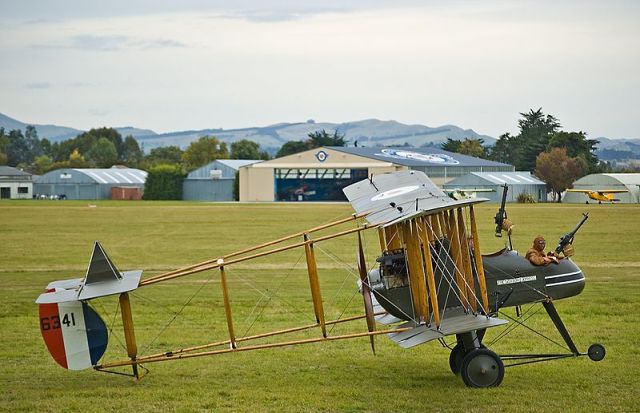
Aircraft Serial Number A813 2Lt DP Walter [Pilot] 2 Lt AM Taylor [Obs/Gunner]. Patrol. Take Off 1.05pm Return 3.45pm. Remarks Alt 9,000ft Vimy – Arras.
Aircraft Serial Number A4925 Sgt WJ Burton [Pilot] Sgt JH Brown [Gunner]. Escort. Take Off 1.15pm Return – Remarks Forced landing at 16 Sqn Aerodrome owing to engine trouble at about 3.45pm. Fired at two hostile machines over Lievin. They went away.
Aircraft Serial Number A4925 Sgt WJ Burton [Pilot] Sgt JH Brown [Gunner]. Remarks Take off from 16 Sqn Aerodrome at 5.00pm Altitude 1,000ft landing at 25 Sqn at 5.10pm.
Aircraft Serial Number A6383 Lt HE Davis [Pilot] 2 Lt HE Freeman-Smith [Obs] Photography. Take off 3.17pm Return 4.40pm Remarks Altitude 11,500ft Mericourst – Gavrelle. 12 photographs taken on line Mericourt – Gavrelle. 4.10pm attacked by 2 hostile machines over Mericourt.
Aircraft Serial A6382 2 Lt DP McDonald [Pilot] 2 Lt JI
O’Beirne [Obs] Photography. Take Off 3.12pm. Remarks: Reported missing; report being sent in.
Aircraft Serial A6371 Lt L Dodson [Pilot] 2 Lt HS Richards
[Obs] Escort. Take Off 3.15pm. Remarks: Reported missing; report being sent in.
Aircraft Serial A7683 Sgt J Dempsey [Pilot] Sgt CH Nunn
[Obs] Patrol. Take Off 3.25pm. Remarks Not returned by 6pm.
Aircraft Serial A5484 Capt CHC Woolven [Pilot] Sgt J Booth
[Obs] Patrol. Take Off 3.30pm. Remarks Not returned by 6pm.
Aircraft Serial A7024 2 Lt B Mewes [Pilot] 2 Lt BC Moody
[Obs] Patrol. Take Off 3.35pm. Remarks not returned by 6pm.
Aircraft Serial A7696 2 Lt EVA Bell [Pilot] 2 Lt EG Green
[Obs] Photography. Take Off 4.55pm. Remarks not returned by 6pm.
Aircraft Serial A784 Capt LL Richardson [Pilot] 2 Lt DC Wollen
[Obs] Escort to A7696 Take off 5pm. Remarks not returned by 6pm.
Aircraft Serial A7025 2 Lt DP Walter [Pilot] Lt GMA
Hobart-Hampden [Obs] Patrol. Take Off 5.05pm. Remarks not returned by
6pm.
Aircraft Serial A4847 2 Lt RG Malcolm [Pilot] 2 Lt NW
Morrison [Obs] Patrol. Take Off 5.07pm. Remarks not returned by 6pm.
So in summary on the 3 April in the 5 hours between 1pm and 6pm it looks as if it had been an absolute disaster for the squadron but though seven aircraft had not returned by 6pm they did all eventually return. The squadron only lost the two aircraft; A6382 McDonald and O'Beirne and A6371 Dodson and Richards. However this was Bloody April for the whole of the RFC whilst they fought a losing battle against superior German aircraft when aircrew lives could be measured in days or at best weeks. So what had happened? By referring to three books; The Sky Their Battlefield: Trevor Henshaw, The Jasta War Chronology: Franks Bailey and Duiven and Casualties of the German Air Service: Franks Bailey and Duiven we can piece together the overall picture for the two missing aircraft.
Three aircraft; A6383
Davis and Freeman-Smith, A6382 McDonald and O'Briene and A6371 Dodson
and Richards. A6383 and A6382 photography and A6371 as the escort.
A6383 completed the air task and returned. A6382 completed their
air task and were on the return with A6371 as close escort
when both aircraft were attacked by enemy aircraft. A6382
was attacked near Vimy Ridge. The engine and controls were hit and
O'Briene was killed. The aircraft was forced down near Lens at about
4.30pm and the aircraft caught fire after the crash landing. McDonald
was taken prioner. The combat was claimed by Oblt M von Richthofen of
Jasta 11.
Our interest
concentrates now on Aircraft A6371 with Dodson
and Richards. Whilst still circling over the Lens area and escorting
the the photo aircraft [A6382] they were attacked by Jasta 11
equipped with Albatros DIII, this may be likened to a nut being hit by
a
sledgehammer, not made any better when you learn that the Commanding
Officer of Jasta 11 was Manfred
von Richthofen. The two aircraft were soon shot down.
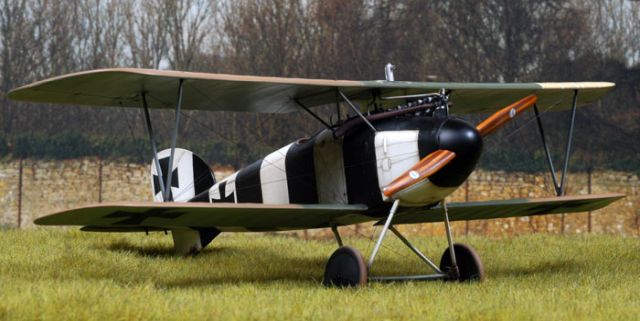
Albatros DIII Operational ceiling 18,000ft. Maximum Speed 109mph. Armament two Spandau Machine Guns.
A6371 with Dodson and Richards was attacked by Lt Karl Schafer from above and from rear left to front right. It was to be
Schafer’s 18th
victory. Karl Schafer in his combat report states
that he was much lower than the enemy aircraft [Dodson / Richards] and he had
to fly his machine hard to claimb above them. Once he had the advantage
of height he kept forceing the Britsh aircraft lower and lower toward
the ground.
Dodson was uninjured but Richards had been shot three times in the stomach. Dodson managed to bring the aircraft down in open ground and crash landed, part of the engine and propellor were damaged during the attack. He then dragged himself out of the cockpit and proceeded to attempt to help Richards by which time enemy infantry had arrived. Dodson was led away and he last saw soldiers gathered around Richards now out of the aircraft and laying on the ground being given medical aid. Dodson was taken back through German lines and was taken to a prisoner of war camp where he remained until the end of the war, at the time he assumed Richards had survived and had also been taken prisoner of war.
Karl Schafer would go on to shoot down a total of 22 aircraft before being killed himself when he was shot down by Harold Satchell / Lewis Tams in a FE2d of 20 Sqn RFC on the 5 June 1917.
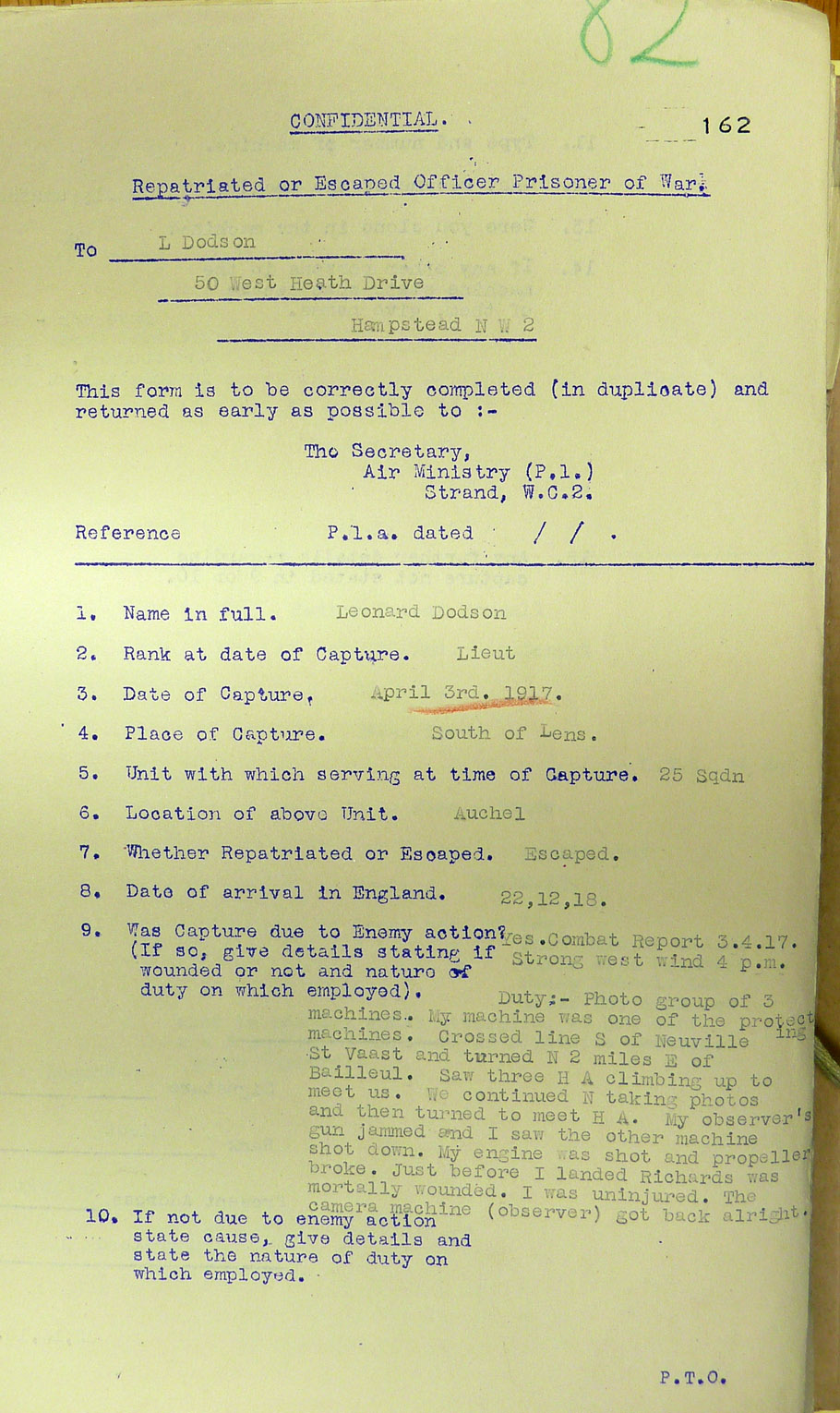
Here is a copy of the combat report written by Dodson on his return to England in 1918.
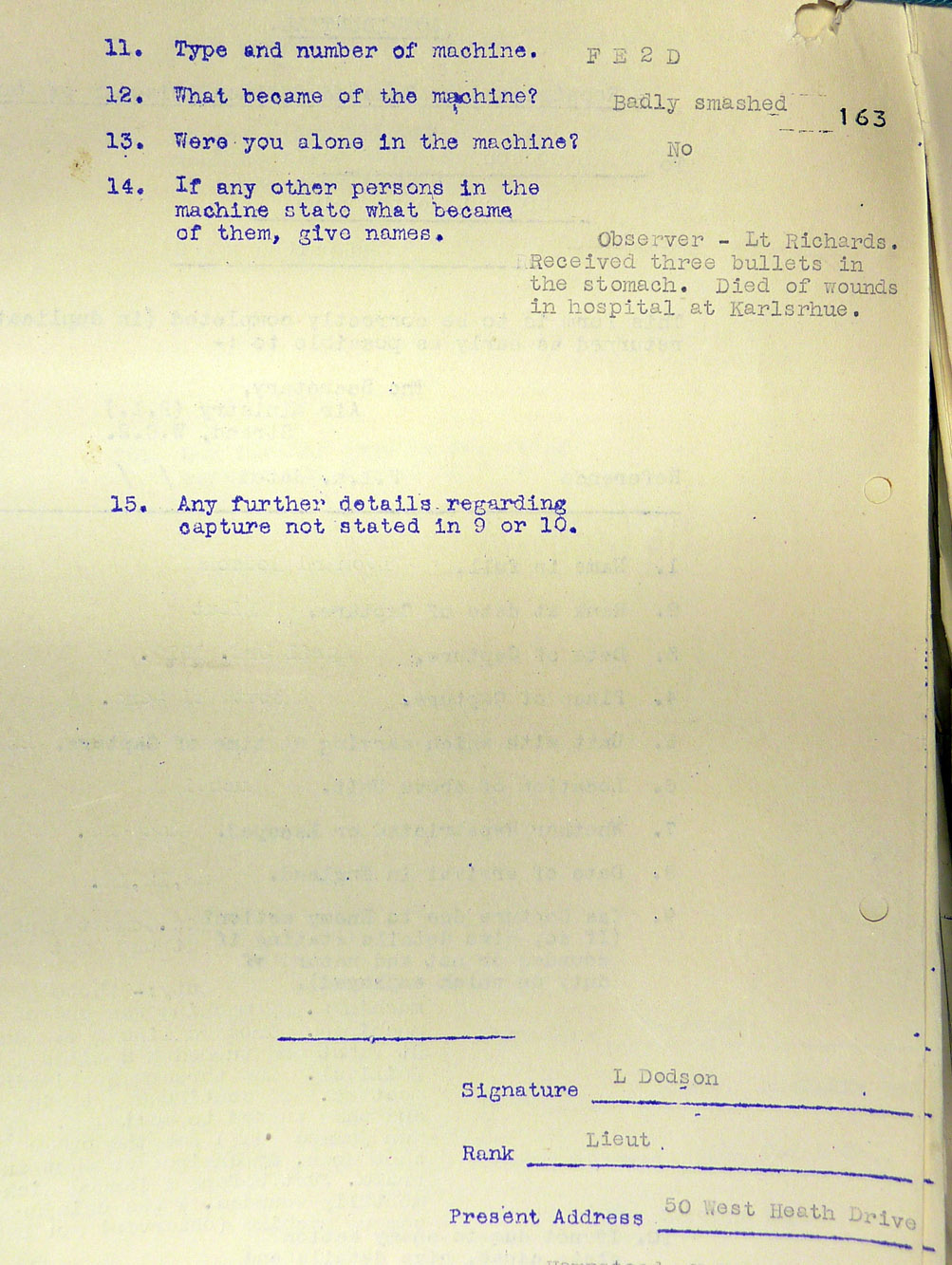
The inference now is
that if Richards was shot three times in the stomach, and we know that
Schafer ran his attack from high and behind and crossing over the top
of A6371 it must be believed that
Richards was stood up in the nacelle of the aircraft and facing backwards firing to the
rear of
the aircraft over the wing at Schafer coming down and across at them
until the point where his gun jammed.
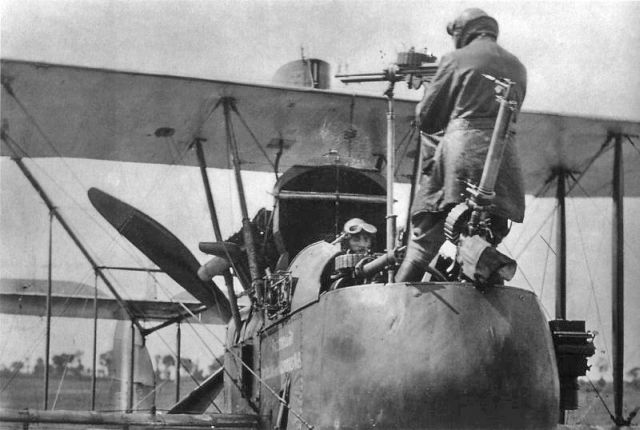
Here is a quote from Frederick Libby an FE 2b Observer about being the gunner in a FE 2b to set the scene.
“When you stood up to shoot all of you from the knees up was exposed to the elements. There was no belt to hold you. Only your grip on the gun and the sides of the nacelle stood between you and eternity. Toward the front of the nacelle was a hollow steel rod with a swivel mount to which the gun was anchored. This gun covered a huge field of fire forward. Between the observer and pilot a second gun was mounted for firing over the FE 2b upper wing to protect the aircraft from rear attack. Adjusting and shooting this gun required that you stand right up out of the nacelle with your feet on the nacelle coaming. You had nothing to worry about except being blown out of the aircraft by the blast of air or tossed out bodily if the pilot made a wrong move. There were no parachutes and no belts.”
You will note the remarks made by Dodson to question 14 in his combat report. he states [in good faith and taking into account it was over a year since the event] that Richards being wounded was taken to a hospital in Karlsrhue. This is not correct. Dodson was taken to a POW camp in Karlsrhue and makes the assumption that Richards was taken there also, Dodson also makes the assumption that Richards being wounded would have been taken to a hospital. Dodson being led away shortly after the crash was unaware that Richards died of his wounds shortly after the crash landing and the Germans buried him in the German Extension of Avion Cemetery on the 4th April.
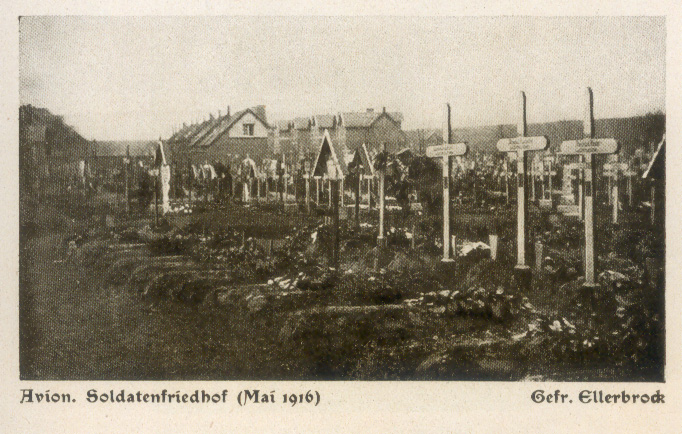
Postcard showing the German Military Extension of Avion Cemetery [dated May 1916]
So in essence it might be believed that would be the end to the story. The War Office wrote to Jessie Richards on the 20 April 1917 to inform her Henry was missing in action with effect of 3 April and if they received any further information they would inform her. The War Office wrote again to Jessie on the 1 May 1917 informing her that no other information had come to hand and that 2Lt Henry Scotson Richards must now be assumed as dead and the Army Council added to Richards records that death was accepted by the Army Council as having occurred on 3 April 1917.
Now if the War Office thought that would be the end of the matter then they had not bargained without Jessie Richards. Jessie Richards hitched up her skirts and went on the warpath.
Jessie at first would not believe Henry was dead then when she did accept that fact she waged war on the War Office for his belongings and outstanding pay. There now started a series of letters beginning in June 1917 and not ending until July 1929. I will just précis the subject of the letters for you, it does all add to the overall story.
6 June 1917 War Office to Jessie Richards.
Information and a report that 2 Lt Richards now unofficially reported as wounded and a prisoner of war.
20 June 1917 Jessie Richards to War Office.
What report, where did report come from, where is my son.
27 June 1917 War Office to Jessie Richards
A letter received from the father of 2 Lt Dodson that Dodson had written to his father to inform him of the actions on the 3 April and that he believed Richards survived his wounds and was a prisoner of war. The War Office for the moment taking this as true subject to confirmation and thought Mrs Richards would like to know this information. However if the report was found to be untrue then notification would be sent to Mrs Richards soonest.
19 July 1917 Jessie Richards to War Office.
Have you any more information. Tell me more about these reports, were is my son if he is a prisoner, is he well, how was he wounded.
28 July 1917 War Office to Jessie Richards.
We have now received a letter from 2 Lt Dodson stating that 2 Lt Richards is a prisoner of war in Germany. Also in a German newspaper ‘Flugsport’ Lt Richards name is shown with Lt Dodson as prisoners of war. We do not know which camp he is being held in we are making more enquiries.
27 August 1917 Jessie Richards to War Office.
Have you any more information regarding my son. You say he might be a prisoner of war and that he is wounded I am worried about all this. Why is nobody able to help me with my questions, where is my son.
1 September 1917 War Office to Jessie Richards.
In reply to your letter 27 August I am instructed to inform you that it has now been reported and confirmed from the Base in France by a message dropped by a German aeroplane over our lines that it is now confirmed that 2 Lt Henry Richards was killed. The fact you have not heard from him since he was reported missing on 3 April the Army Council fear there is no hope he is alive. However we have sent an enquiry to Germany.
24 September 1917 Jessie Richards to War Office.
You had told me he was alive, wounded and a prisoner of war. You told me you had reports from both the Father of 2 Lt Dodson and from 2 Lt Dodson himself saying my son was alive and a prisoner. What do you mean a German aeroplane dropped a message, what exactly did this message say. Where is my son.
1 October 1917 War office to Jessie Richards
The only information we have at this time is that a German aeroplane dropped a message into our lines stating 2 Lt Richards was killed. We are still awaiting an exact copy of the message from France and this will be communicated to you when we receive it.
11 October 1917. War Office to Jessie Richards.
It is with regret we must now inform you that we have a copy of the official list now received from German authorities and it is reported on this list that 2 Lt Richards died of wounds during the night of 3 April 1917. In light of this it is concluded that 2 Lt Richards died of his wounds after he was brought down and after he was last seen by 2 Lt Dodson. Publication will now be made in official casualty lists.
13 October 1917 Jessie Richards to War Office.
I am surprised at the report of my son. I also wrote to 25 Sqn and asked for a copy of the note dropped by the German aeroplane and of the list of officers lost in April it only shows the name of Richards and you concluded it must be my son. I have had a letter from the RFC Aid Committee that 2 Lt Richards is a prisoner of war and his name is shown in a German newspaper. His name is on a list of officers held at Limburg, he has written three letters but all were returned unopened. Where is my son.
20 October 1917 War Office to Jessie Richards.
In reply to your letter 13 October. It is regretted that there is no reason to doubt the accuracy of the report of your son’s death in the official report from Germany. It appears that he was alive when first captured and was last seen by 2 Lt Dodson but that he died later that night. The point that his name was reported in a German newspaper may have been that the paper went to print prior to understanding that he had died. In relation to your statement about the RFC Aid Committee and reports of an officer named Richards a prisoner at Limburg this office can assure you that after checks we can confirm that officer is Lt ARM Richards born at Farford and not your son. It must now be accepted as reliable that 2 Lt H Richards died on the 3 April.
Jessie now comes to the sad conclusion that Henry is dead and regrettably has to agree with the information from the War Office. The War Office may have now been able to breathe a sigh of relieve but Jessie took a deep breath and moved up a gear.
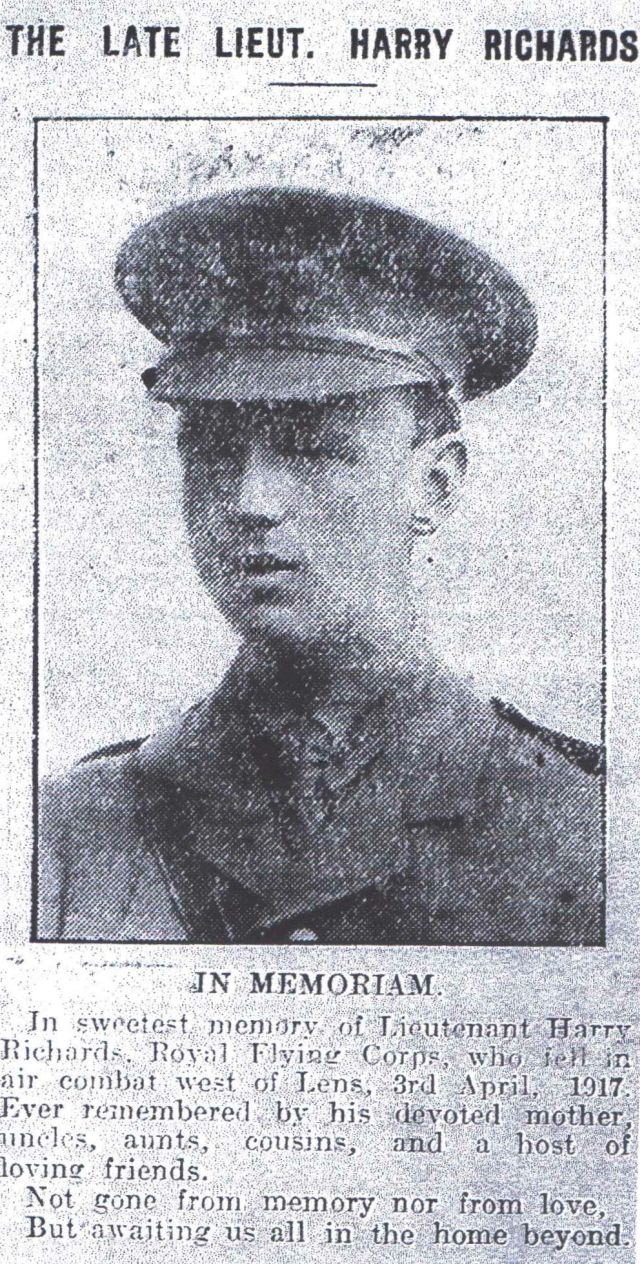
25 October 1917 Jessie Richards to War Office.
It was with the deepest grief to read your final opinion. Yet I shall hope within myself that this dreadful war is soon over. How about compensation for the loss of my only son. I was left with two young children and started to work in a millinery business when my son was 18 months old about 20 years ago, in order to give him a good education and to apprentice him to a good profession. It took all my savings for many years. When the war broke out he was making good headway as an analytical chemist with 3 years through. Having practically a man to keep without a wage, the little money received was no more than pocket money and I had to keep working hard. Consequently my health failed and through the last 6 months it has finished me in working business and now I shall have to continue living out my days on a small income, because my son would have repaid my life’s work had he been spared. My son informed me that he had made a will in my favour, has he left it with you or perhaps you will kindly instruct me how to go on. My son did not make a separate allowance for me. My son assured me I would be allowed a small pension from you should he be killed. I am over 50 years of age and alone having lost my only daughter at 16 years of age. So you will understand I want a little consideration in money matters. I wrote to Cox Bankers about my sons affairs since he was reported missing and he was £15 to his credit. I am only one of many suffering mothers but I again repeat mine is a sad case as my son was all I had and without a good son which I had relied on for the future years together to look after me what am I do in this situation.
PS. May I remind you my son was over German lines doing very important work when he was taken from me.
3 February 1918 Jessie Richards to War Office
I am enquiring about the property and effects of my son 2 Lt Henry Richards RFC who was killed on 3 April 1917. It is almost a year now since my son was taken from me and I have not received any of his effects. Could you let me know what is happening to this matter?
29 May 1918 Jessie Richards to War Office
I wrote to you in February about some belongs of my son the late 2 Lt Henry Richards RFC and Notts and Derby Regt. I understand from a letter I received from the Netherland Legation [British Section] in Berlin that some British Officers effects were being sent from Berlin to the British Minister for War. There is I understand a watch and ring belonging to my son and I am very anxious to have the same and would like to hear from you.
2 June 1918 Jessie Richards to War Office
Thinking there may be some misunderstanding in claiming my sons watch and gold ring I enclose a copy of the letter I received from Germany about these effects. I am longing and waiting anxiously to see these items the last things he wore. I can imagine and see him looking at his watch and ring and they will be treasured keepsakes. Do your best please to forward same to me.
13 June 1918 War Office to Jessie Richards
With reference to your letter regarding the effect of 2 Lt Richards RFC I am instructed to inform you that included in a consignment of effect returned to this country from the German Government there is a package containing a watch [damaged] and a gold ring the package bearing the name Richards. As no other deceased officer with this name can be traced in the RFC it is presumed that these are the articles of which you received advice from the Prisoners Enquiry Department in Berlin. I am however to inform you that the ring bears an inscription on the inside “Edward A Doughty to Donald William Edwards 1910” it is therefore presumed that this is the property of the late Captain DW Edwards MC ASC and RFC who was killed over German lines on 6 April 1917. In these circumstances it is proposed to send the ring to this officer’s next of kin. The watch is being forwarded to you.
1 October 1918 WJS & JAS Scott Lawyers in Newcastle to War Office
Re 2Lt HS Richards RFC and Notts and Derby Regt.
We have acted for the mother of the deceased for about 20 years. She is an exceedingly hard working lady who entirely by her own exertions has been able to educate her son at a public school and article him to an Analytical Chemist in the city. We understand the deceased did not leave a will. Her husband was, and no doubt is still, if living, an utterly worthless character. He was a journalist and the last information respecting him we obtained, many years ago was that, he was doing odd journalistic jobs in Fleet Street. We do not know if the father is alive or not. It would be an exceedingly hard case if any money that may be due or payable or intended to be paid to the representatives of the deceased should fall in to the hands of his father, not only because he has never contributed to the support of his child since the child was an infant. If it was discovered and the father saw the opportunity of obtaining any money he might return and become a nuisance to his wife. Indeed it has always been a dread hanging over her head that he should present himself and endeavour to make her support him. We shall be glad to hear from you again regarding this matter.
6 October 1918 Jessie Richards to War Office
I am the mother of the late 2 Lt Henry Scotson Richards Notts and Derby Regt and RFC who was killed whilst flying over German lines on 3 April 1917. He became an officer in the early part of 1915 and when he returned home from Keble College in June 1915 that he told me that he had made a will leaving all to me his mother. When I asked where it was he said it was left with Messer Cox Bankers, I understand that it was the custom to do so. He was very truthful and would not tell me he had made a will when he had not.
18 October 1918 War Office to Jessie Richards
I am directed to acquaint you that in the absence of a will directing otherwise the amount due from Army funds to the estate of the late 2 Lt HS Richards RFC is by law the property of his father and cannot be paid to any other person without the fathers permission unless proof of his death is forthcoming. Enquiries have been made at Messrs Cox and Co who state that they are unable to trace the receipt of any will executed by the late officer. However your statement that he reffered verbally to the disposal of his estate in the event of his death you are requested to state:
[1] The date, when and place where the statement was made
[2] The exact words
[3] The names and address of any persons other than yourself who were present at the time and heard the statement.
The amount in the hands of this department due to the estate has now been increased to £19.6.2d.
29 October 1918 WJS & JAS Scott Lawyers in Newcastle to War Office
Our client Mrs Richards who is very unwell at the moment has asked us to reply to your letter of 18th.
[1] The date when and place where the statement in reference to the deceased’s will was made on a Sunday evening in May 1915 at Stockton Road West Hartlepool.
[2] The deceased was recommended for a commission in February 1915 and went to train at Keble College Cambridge and returned home in May 1915.
[3] The exact words were: “mother I want to talk to you specially. I have made a will in your favour and should I go under you will receive a pension of £80 seeing as you have always worked to bring me up” Mrs Richards replied “Where is the will left” and the deceased said “at Cox’s” he also said that the Will Form had to state where he was born and he had put West Hartlepool on the 26 January 1896.
[4] There was no one present when the statement was made with the exception of the deceased and his mother. They were living alone at the time.
15 November 1918 Jessie Richards to War Office
I sent to my solicitors to reply to your last letter of inquiry re my late sons Will. I was ill with influenza at the time. Now what I have told you is quite true. My sons master took a great interest in him and had he been spared to return a good position awaited him. To keep my boy and work for money to keep him at school for a good education was a great denial to me but he was worth it being very clever. In fact the head Master at Barnard castle School said on my taking him away at the age od 16 that he had gone as high as possible and if I could afford to make a University man of him he would advise me to make the effort. However I decided to give him a good profession and there was every promise of a fine career before him and he said he would keep me in comfort because he loved his mother who had done so much for him. When you send the money due to his estate kindly let me have it direct. If there is any more question to be answered on the matter I can give a truthful statement.
10 July 1919 Jessie Richards to War Office
Will you kindly give the matter about the money owed to me from my late sons estate, I am grateful enough for the £30 pension granted to me, it ekes out my living a little. I have not seen my husband in many years, in fact I have not seen him in many tens of years. I had taken him in his absence before a magistrate who granted a maintenance payment from him and despite him promising to pay a monthly maintenance for my two children I have never received anything from him, ever. Anyway if my husband was to turn up now, if living which I doubt after these many years, he would be owing me hundreds of pounds in unpaid maintenance. I have had a letter from his pilot Lt Dodson of Hampstead who is a returned prisoner of war. He said that they completed the job they had set out to do and that my son died a hero’s death. He fired at the enemy machine to the last. So help me if you can trust has always been my watchword and if anything should happen I shall take the responsibility if you pay the money to me.
2 September 1919 Jessie Richards to War Office
I write to you to ask if there is anyway you can bring about the settlement of my late sons estate. I have not seen his father for tens of years and it is absolutely impossible to trace him even he might be dead by now. It was about 24 years ago when my son was only some months old that his father went to London to make a fresh start, due to his own folly, and I have not seen him since and we have not lived together since the day he departed. My son was most anxious about me being left and alone and made a will in my favour which you cannot find. Please do your best to bring this matter to a settlement.
By the middle of September 1919 Jessie was back in Wolviston. She had purchased Western House.
12 September 1919 WJS & JAS Scott Solicitors in
Newcastle to War Office
We have acted for Mrs Richards for over twenty years and know her affairs intimately. Her husband deserted her some 20 odd years ago and we took proceedings for her for maintenance that was awarded in her favour but to our knowledge no payments have ever been received. There is every reason to believe having regards to his habits that he is no longer alive. Mrs Richards brought up her two children, gave them both a good education and sent her son to a public school and denied herself in every way towards his advancement. Mrs Richards has no private income save the £30 a year pension awarded to her. It would be a great hardship if the £101.2.2dfell into the hands of the utterly worthless character she married. If the money should be paid to Mrs Richards we would be willing to act and give an undertaking to ensure to repay the money to the husband should it turn out that he is alive.
There is now a gap in
any letters held in the file at the National Archives. The next letter starts.
2 March 1925 WJS & JAS Scott Solicitors in Newcastle to War Office.
Re 2 Lt HS Richards RFC and late Notts and Derby Regiment
Our client Mrs
Richards has observed an advertisement that
the sun of £101.2.2d is lying to the credit of the deceased. Our client
has
failed to learn anything whatever of the whereabouts of her husband
from whom
she has been separated for very many years. Are there no mean by which
the
money above referred to can be paid to her. It will be remembered here
that her husband Israel Richards had died in London three years earlier
but Jessie Richards or anyone else for that matter was not to know that.
7 March 1925 War Office to WJS & JAS Scott Solicitors in Newcastle
With reference to your last letter I am directed to acquaint you that, as you have been previously informed, this department is unable to dispose of the amount due to the estate from Army Funds without the production of a Grant of Representation to the estate, ie probate of Will or Letter of Administration. The amount due to the estate is advertised in accordance with the provisions of the Regimental debts Act 1893.
There is again
another gap in letters from the file at the National Archives. The next letter
starts.
19 January 1926 Jessie Richards to War Office
In reply to your advertisement re unpaid balances of deceased soldiers and airmen I beg you to consider the mother of 2 Lt HS Richards RFC and Notts and Derby Regiment. I have not heard anything of his father and it is nearly nine years since my boy was killed. His gratuity money would be very helpful to me owing to my health not being so good.
28 January 1926 War Office to Jessie Richards
With reference to your letter of 19th instant. I am directed to inform you that the amount due from this Department to the estate is £101.2.2d. As this amount exceeds £100 this Department has no power under the Regimental Debts Act 1893 to issue any part of it except on the production of a Grant of letters of Administration of the late Officers estate. I am add that the amount due is advertised by this office under the provisions of the Act above quoted.
There is again
another gap in letters from the file at the National Archives. The next letter
starts.
29 May 1929 Jessie Richards to War Office
Is it possible for you to pay me my late son’s war gratuity? Believe me the sum owing would help and do me so much good at present as I am over 62 years of age and not in the best of health. Costs of property, heating and repairs to the roof to keep this property right are to much for me and my health is failing due to the worry of it all. Please consider my trying position.
8 June 1929 Internal War Office Memo
Missing Father Case Re estate 2Lt HS Richards RFC late Notts and Derby Regiment
The amount involved is £101.2.2d compound of £96.2.2d actually due to the estate at date of death plus a rankers war gratuity of £5.n We have previously told the late officers mother and solicitors acting on her behalf that we are unable to pay over any part of the sum due without production of a Grant of Representation, but in view of the decision mentioned above it seems we can, if we feel inclined, to dispose of the amount without requiring Letters of Administration. The chief difficulty is the size of the sun at stake. The mother’s case merits sympathetic treatment and if the amount were smaller we would have issued it to her on guarantee to refund if required. Submitted for consideration whether we [a] issue on guarantee [b] maintain our requirement for letters of administration. I suggest the first course of action.
24 June 1929 Jessie Richards to War Office
I am obliged for your letter informing me of your decision to pay me the estate of my late son. I intend to use some of the money to purchase a memorial for my son so that his memory will live on. He was buried in Germany and later re-interred in France. My nephews went to see the grave and a wooden cross was there with my sons name on it. When I am better and may afford to do so I intend to go and see his grave for myself. * See note at end.
27 June 1929 War Office to Jessie Richards
With reference to the estate of the late 2 Lt HS Richards RFC late Notts and Derby Regiment. The estate is made up as follows:
Gratuity under the Royal Warrant for pay £111.12.0d
Less pay and allowances over issued £15.9.10d
Plus gratuity for service in the ranks prior to commissioning £5.0.0d
I am to explain that the Gratuity for Service in the Ranks prior to commissioning [£5] was not in force at the time of the late officers death and this Department is advised that it does therefore legally form part of his estate. The deduction of the £5 then reduces the sum payable to less than £100 and so the Letters of Administration are not required. However and as an act of grace we are prepared to issue the full amount of £101.2.2d to you on the completion of you completing and returning the forms of guarantee to this office.
8 July 1929. War Office to Jessie Richards
With further reference to the estate of the late 2 Lt HS
Richards and our letter dated 27 June 1929 I am directed to enclose a bankers
draft for £101.2.2d in your favour and representing the total amount of the
deceased officers estate.
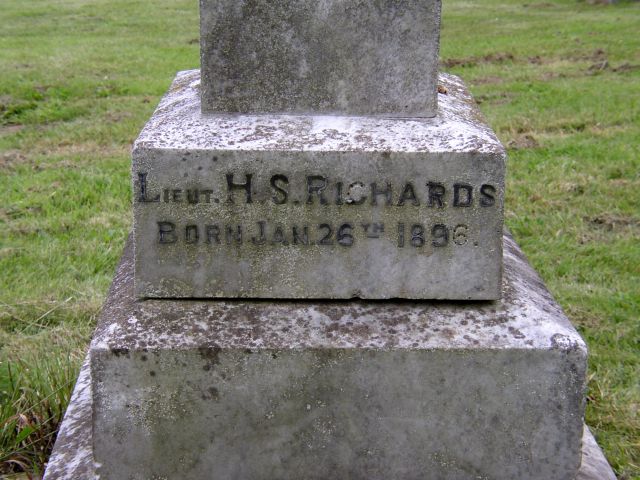
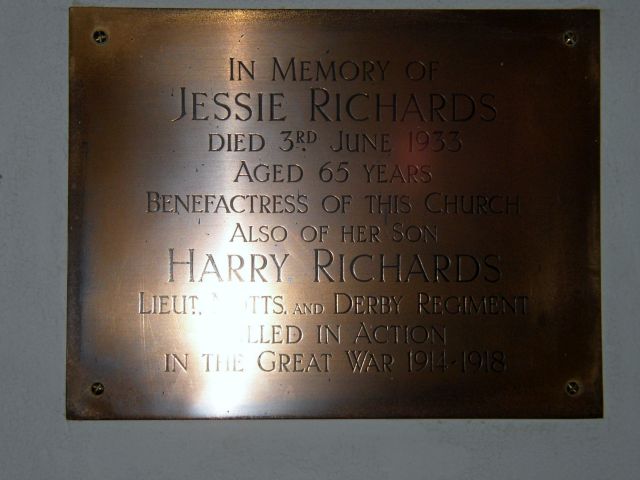
Re Note
on letter dated 24 June 1929
Jessie
mentions in this letter that Henry was buried in Germany and later re-interred
in France. She also mentions that her nephews had visited the grave and had seen a
wooden cross with his name on it. This is untrue.
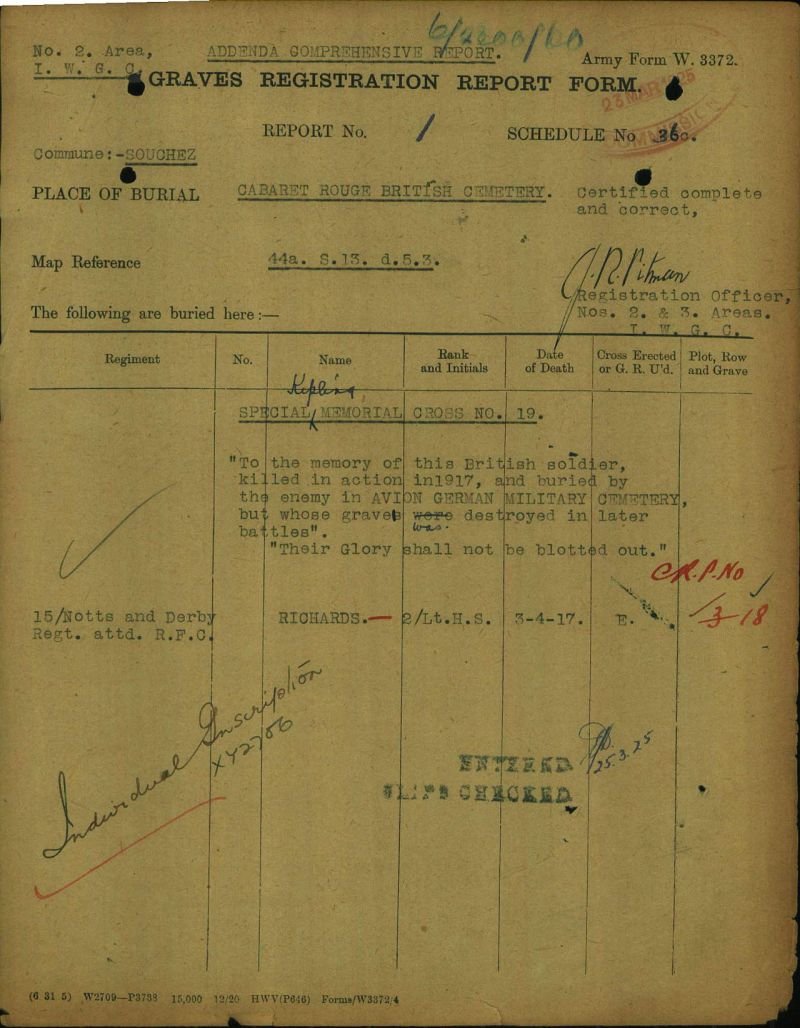
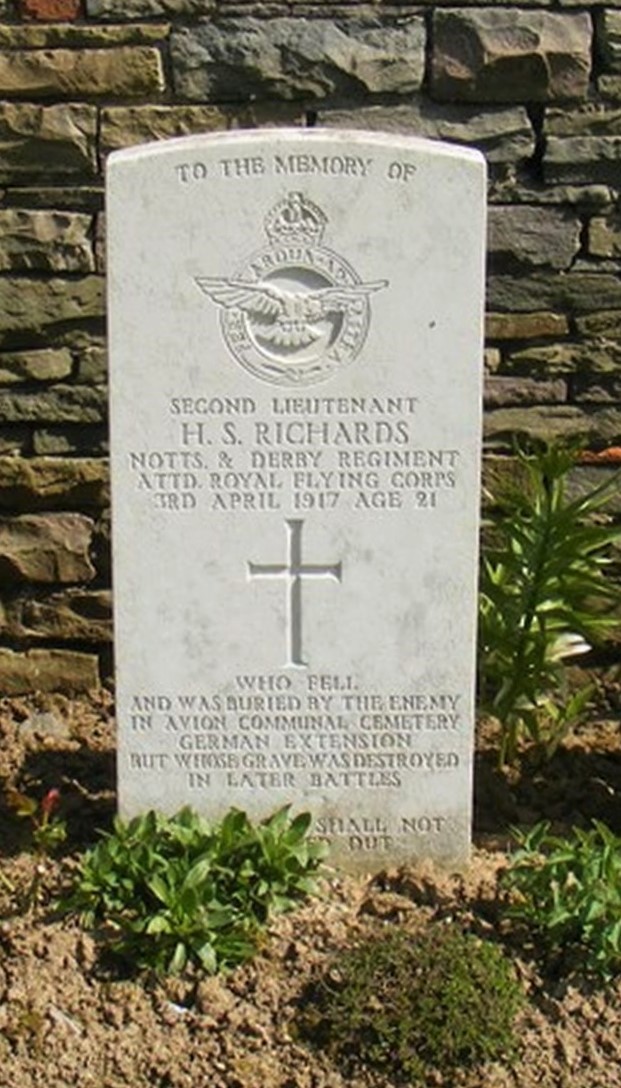
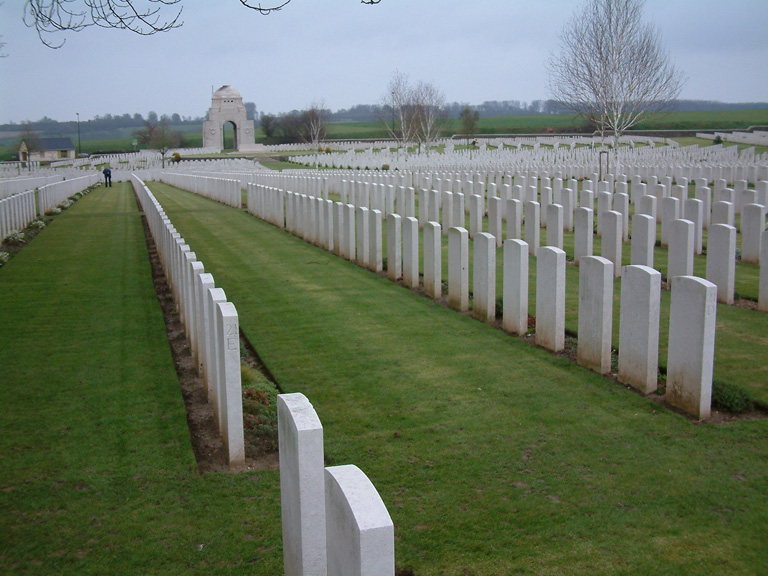
Caberet Rouge was a small, red-bricked, red-tiled café that stood close to this
site in the early days of the First World War. The café was destroyed by
shellfire in March 1915 but it gave its unusual name to this sector and to a
communication trench that led troops up the front-line. Commonwealth soldiers
began burying their fallen comrades here in March 1916. The cemetery was used
mostly by the 47th (London) Division and the Canadian Corps until August 1917
and by different fighting units until September 1918. It was greatly enlarged
in the years after the war when as many as 7,000 graves were concentrated here
from over 100 other cemeteries in the area. For much of the twentieth century,
Cabaret Rouge served as one of a small number of ‘open cemeteries’ at which the
remains of fallen servicemen newly discovered in the region were buried. Today
the cemetery contains over 7,650 burials of the First World War, over half of
which remain unidentified.
So in essence that is the story of Henry Scotson Richards 25 Sqn RFC and late 15 Battalion Notts and Derby Regiment. An officer who went through parts of the the Somme campaign without so much as a scratch but survived only 24 hours when posted to 25 Sqn RFC being killed during his first operational flight the day after arriving there.