|
1914 STAR
|
||
|
.
|
In 1917 King George V
approved the grant of the 1914 Star, often referred to as the Mons Star,
to all those officers and men of the British and Indian Expeditionary
Forces, including civilian medical practitioners, nursing sisters, nurses
and others employed with military hospitals, who actually served in France
or Belgium on the establishment of a unit between 5th August 1914 and
midnight on the 22nd/23rd November 1914. Officers and men of the Royal
Navy, Royal Marines, Royal Naval Reserve and Royal Naval Volunteer Reserve
who served on the establishment of a unit landed for shore service in
France or Belgium between those dates are also eligible, but not
those who served afloat. On the 19th October 1919 it was announced that
the King had approved the issue of a clasp to those already awarded the
1914 Star who actually served under fire of the enemy or were present
on duty within range of the enemy mobile artillery in France or Belgium
and on the strength of units and formations contained in the official
lists between the 5th August and midnight 22nd/23rd November 1914.
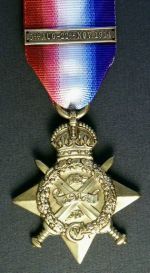
The 1914 Star is a bronze four pointed star with the uppermost point being replaced by a crown. Across the face of the star are two pointed swords, blades upward, the blades and hilts protrude and thus form additional points of the star. In the centre are three scrolls, on the top is the month AUG, the centre shows 1914 and the bottom the month NOV. The scrolls are surrounded by a laurel wreath and the bottom of the wreath is subscribed with the Royal Cipher GV (with the V inside a larger G). The watered ribbon is shaded left to right: red, White and Blue. The recipient of a bar wears a small silver rosette on the ribbon in undress. Approximately 378,000 medal plus 145,000 bars were awarded. Return to British Service Medals
|
|